
Victoria County Court Docket Searches
Start at the official Victoria County Records Inquiry. The landing screen splits the docket search into tracks. You get Criminal Case Records, Civil/Family/Probate Case Records, and Court Calendar. Pick the record family first. Only then enter a name or cause number. Felony cases and district civil or family files live with the District Clerk. County-level misdemeanors, probate, juvenile matters, and county civil cases belong to the County Clerk. A city citation or a justice-court claim has its own clerk entirely.
A precise cause number beats a name every time. Name searches pull up several people. One event can also spawn records in more than one Victoria County court. So keep the court name, case style, and setting type next to that number. Check the online result against the current calendar. Or check the clerk's answer before you rely on it.
- Identify whether the matter is district, county, justice, municipal, appellate, or federal.
- Open the official portal and choose the matching record family.
- Search by cause number when known, or use the name and date filters supplied by the form.
- Open the result and compare its court, style, status, filings, and newest setting.
- Call the clerk or coordinator when a date is close, a result is absent, or a certified copy is needed.
Odyssey Starts the Local Search
Odyssey asks you to choose a path before any query runs. Criminal, civil/family/probate, and calendar searches sit on separate tracks. The official customer instructions lay out the criminal options. You can search by case, defendant, citation, or attorney. The name form wants last and first name. Add a middle name, birth date, status, or a filed-date range. Each one narrows the docket results further.
| Search control | Use | Research limit |
|---|---|---|
| Case or cause | Best route when the full identifier is known | Legacy formats may differ |
| Defendant or party | Use full name and compare the court | Do not assume the first match is correct |
| Case status | Choose All, Open, or Closed | Status is not a certified outcome |
| Filed dates | Limit older or newer filings | No official maximum range is stated |
| Attorney | Locate matters tied to known counsel | Confirm the style before relying on it |
The county guide makes no promises about wildcards, fuzzy matching, exports, or a full all-years archive. A blank result is not a dead end. Switch court level, or ask the clerk whether the file is older, on paper, restricted, or kept somewhere else.
Court Dockets: What They Show
Think of a Victoria County court docket as an event list. It is not the whole case file. The weekly civil publication names the court, date, time, judge, and courtroom. It also gives the cause number, case style, counsel, and setting type. The criminal docket goes further. It adds the defendant, attorney, offense, offense date, classification, identifier block, and counts. Those details help you match the right case and follow its stage.
| Cause number | The court identifier, with recent PDF patterns resembling 26-03-xxxxx-A. |
|---|---|
| Case style | The formal caption, such as State of Texas versus a defendant or an In Re matter. |
| Setting | A scheduled event, including arraignment, motion, trial, plea, or judgment entry. |
| Filing entry | A dated notation that a pleading, order, notice, or other item entered the record. |
| Disposition | The recorded resolution or status event, which may need a certified judgment for official use. |
A setting is never an outcome. Seeing a dismissal docket label does not mean every listed matter was dismissed. And an online disposition line is no stand-in for a signed or certified order.
Two Clerks Divide the Files
Victoria County splits its court records between two clerks. The Victoria County District Clerk holds felony, district civil, and family case records. The Victoria County Clerk holds County Courts at Law records: Class A and B misdemeanors, county civil cases, probate, and juvenile matters. Justice Courts keep precinct cases. The City of Victoria handles municipal matters on its own.
Let the case notice or citation lead the way. It usually names the court. Felonies go to the District Clerk, and county misdemeanors to the County Clerk. Small claims, evictions, and many citations outside city limits belong to the named Justice Court, while city Class C and ordinance matters go to Municipal Court.
Fast check: A missing Odyssey result may mean the wrong court was searched. It does not prove that no Victoria County case exists.
Victoria County Courts and Dockets
Four District Courts, two County Courts at Law, four Justice Courts, and one municipal court of record make up Victoria County. Appeals add another layer. The Thirteenth Court of Appeals takes intermediate state appeals, and federal matters go to the Southern District of Texas, not the county portal.
| Court | Docket covers | First search |
|---|---|---|
| 24th, 135th, 267th, and 377th District Courts | Felony, family, major civil, and district matters | Odyssey and District Clerk |
| County Courts at Law 1 and 2 | Class A/B misdemeanor, county civil, probate, juvenile, and lower-court appeals | Odyssey and County Clerk |
| Justice Courts 1 through 4 | Precinct civil, small claims, eviction, traffic, and Class C cases | The specific JP office |
| Victoria Municipal Court | City Class C and ordinance cases | Municipal Record Search |
| Thirteenth Court of Appeals | State appeals from local trial courts | Official appellate search |
An appeal from a lower court can land in a County Court at Law even though the record started in municipal or justice court. A state appeal may carry a new appellate cause number. Keep both identifiers handy.
Victoria Settings Have Many Labels
Victoria County's annual and weekly schedules use labels that say why a case is set. You will see entries like Civil Non-Jury, Criminal and Civil Jury, CPS, New Grand Jury, Entry of Judgment, Motion to Compel, Final Divorce Hearing, and Temporary Orders Hearing. Each label marks a type of event. None of them tells you what the judge decided.
- Arraignment
- An early criminal setting where the charge and plea process are addressed.
- Continuance
- An order moving a setting. The old date can remain in the event history.
- Trial on merits
- A contested hearing or trial on the substance of a civil matter.
- Pro se
- A party appearing without an attorney.
- Ad-hoc
- A special calendar block outside the usual weekly grouping.
Always read the newest setting in context. A case can carry several past settings, and a reset may follow an earlier date. For a near-term trial schedule, the coordinator is still the best source.
Court Dates in Victoria County
Three records work together to pin down a Victoria County court date: the case-specific settings view, Odyssey's Court Calendar, and a dated docket PDF. The District Clerk's weekly civil docket groups settings by court, date, time, and type. Heed its warning that dockets change.
For district settings, the county posts separate civil and criminal coordinator contacts, and County Courts at Law and probate each have their own coordinator. Regular County Court at Law dockets are generally described as Monday and Wednesday at 9:00 a.m., with motions on Tuesday at 9:00 a.m. during non-jury weeks. That pattern never replaces the notice for a specific cause.
- Match the cause number and named court.
- Read the newest setting and any reset entry.
- Check the dated PDF or annual grid.
- Call the proper coordinator when the date is close.
- Keep the written notice and bring it to court.
Note: A calendar result can go stale after a reset. Confirm any urgent Victoria County setting directly with the court.
County and State Portals Differ
Odyssey is the county's everyday interface. re:SearchTX is the statewide court-record and electronic-service environment. Victoria County says attorneys of record get civil activity notices through re:SearchTX starting October 1, 2025. An existing eFileTexas account can be used to register.
Neither channel replaces the local clerk. A statewide account may surface civil activity or filings depending on access rights. Odyssey, meanwhile, locates county cases and settings. The clerk still issues certified records and handles older or restricted files. Attorneys file through eFileTexas. The public should never treat a search result as proof that a filing was accepted.
| Channel | Best use | Not a substitute for |
|---|---|---|
| Odyssey | Local case and calendar discovery | Certified clerk copy |
| re:SearchTX | Statewide activity and authorized filing access | Local schedule confirmation |
| eFileTexas | Electronic filing | Public docket research |
| Clerk counter | Copies, older files, and certification | Legal advice |
Docket Access Under Texas Law
Which rule opens the door depends on the file. Texas judicial records rest mainly on court rules and common-law access. Rule 12 can cover a judicial agency's administrative records. County records that sit outside the judiciary may instead answer to the Texas Public Information Act. A docket, an index, and a budget memo can each answer to a different rule. So one request should never assume a single law covers every record.
Victoria County access framework:
Texas Rule of Judicial Administration 12 provides a route for judicial administrative records, not adjudicative case files.
Texas Government Code Chapter 552 contains the Texas Public Information Act for covered government records.
Texas Rules of Civil Procedure 21c requires sensitive data to be omitted or redacted from filings.
Texas judiciary access policy explains why judicial records do not all follow an agency-record process.
Not everything in a docket is open. Sealed cases, juvenile matters, protected family information, adoption material, and sensitive identifiers may all be restricted. A public docket entry can even show a generic event while the underlying document stays off limits.
Victoria Copies Carry Different Weight
Copies come in grades. A screen view only orients you, and a plain copy simply reproduces an available page. A certified copy adds the clerk's formal certification. An exemplified copy carries added authentication for use elsewhere. Victoria County's two clerk offices publish different fee schedules. The County Clerk states that electronically certified copies are not issued.
| Product | County Clerk | District Clerk |
|---|---|---|
| Emailed electronic copy | $1 up to ten pages, then 10 cents per page | Confirm current method |
| Printed or scanned copy | $1 per page | $1 per page |
| Certification | $5 plus copy charge | $5 plus copy charge |
| Record search | Depends on request and schedule | $5 |
| Exemplification | $10 plus copy charge | Confirm with office |
Fees can change, so confirm before paying. Give the clerk the cause number, court, document title, filing date if known, copy type, and delivery preference, then ask for a total before sending payment.
How Clerks Keep Docket Records
Two clerks split the docket system. The Victoria County District Clerk and the County Clerk each maintain their own share, and both sit at the courthouse complex. Their hours and rooms differ. The District Clerk lists weekday hours ending at 4:45 p.m., the County Clerk page lists service through 5:00 p.m., and another directory entry shows 4:30 p.m. Call ahead if you plan a late visit.
Victoria County District Clerk
115 N. Bridge Street, Room 330
Victoria, TX 77901
(361) 575-0581
District felony, civil, and family dockets.
Victoria County Clerk
115 N. Bridge Street, Room 103
Victoria, TX 77901
(361) 575-1478
County Court at Law, misdemeanor, probate, juvenile, and county civil records.
Aim any mail or counter request at the right clerk. A phone call can settle method and fee questions, though the office may still require a written request or advance payment before it processes a docket lookup.
The Courthouse Has Two Roles
Victoria's courthouse geography pairs a working records center with a historic landmark. The restored 1892 courthouse stands at 101 N. Bridge Street, while most clerk and court services use 115 N. Bridge Street. The criminal coordinator and 377th District Court are among the functions listed at the older address. So the setting notice on your docket entry controls where you report. The official Records Inquiry source shows the county search entry point:
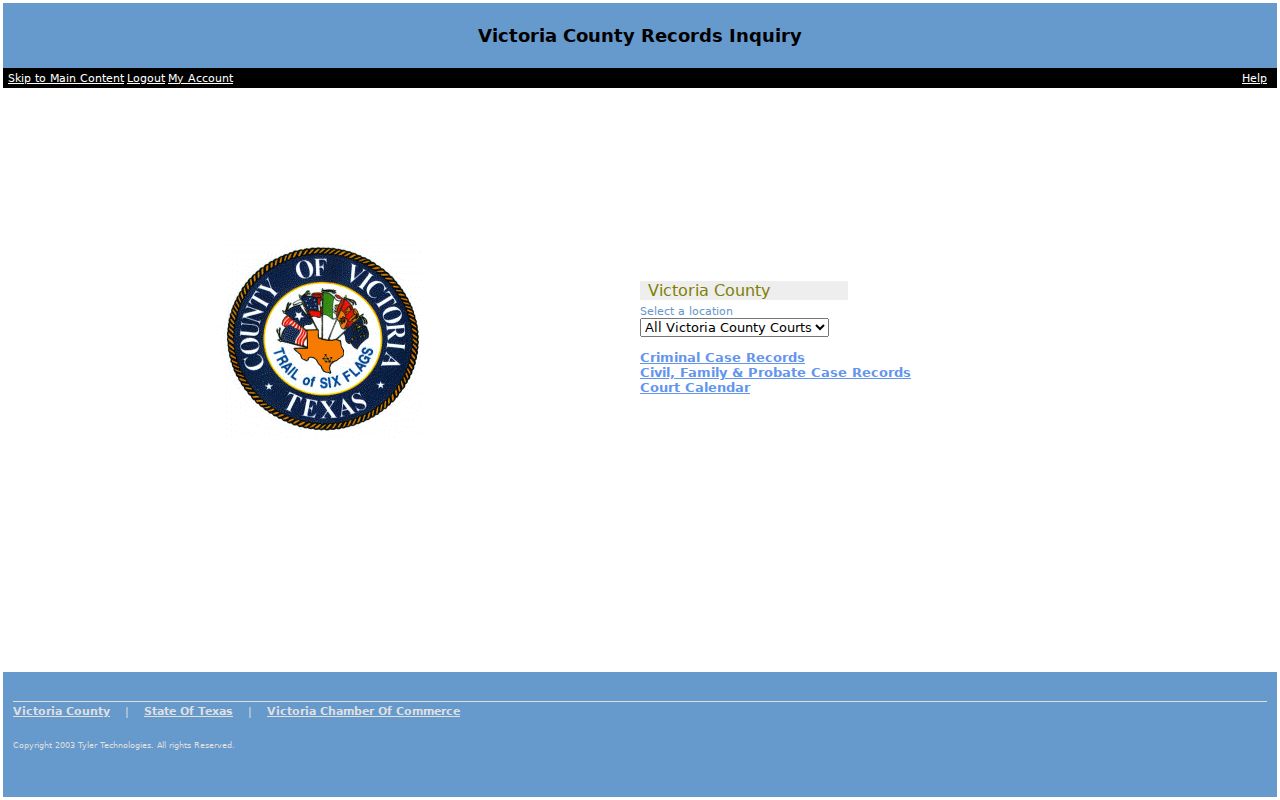
Those separate search choices mirror the split a courthouse visitor runs into. Search the right record family first. Then use the proper counter when the public view is not enough. Security screening and a metal detector apply at the court complex. Room assignments can shift. Call the listed office before arrival about access needs or device rules.
Victoria Caseload Gives Context
Caseload numbers set the scene. In its FY2024 district activity report, the Texas Office of Court Administration recorded 1,586 pending cases at the start for Victoria County, 2,321 added, 2,563 disposed, and 1,344 pending at the end. Those are activity measures. They do not predict how long any one case will take.
The figures help explain why a Victoria County docket holds so many event types and why confirming dates matters. They are neither a backlog score nor a promise about any single court's pace.
City-by-City Dockets in Victoria County
Victoria is the county's only verified incorporated city. Its Municipal Court of Record handles city Class C misdemeanor and ordinance cases. Bloomington, Inez, Nursery, Placedo, Telferner, McFaddin, and other communities do not get separate municipal-court pages here. Matters outside Victoria city limits route by court type and JP precinct.
Victoria Court Records
Search municipal court dates, city citations, dispositions, and available payment or response routes.
Municipal Court: (361) 485-3050
Check the court named on your ticket before anything else.
A higher-level Victoria County case lives in Odyssey instead, so take that case type to the clerk who holds it.
Older Victoria Dockets Need Fallbacks
Older files need patience. The county's customer instructions warn that not all older records were online while archived material was being added. Start with the current Victoria County docket and search by cause number and name. Then ask the correct clerk whether the file has been digitized, remains on paper or microfilm, or needs a staff record search. Give a date range and court whenever you can.
Historical research can cross record systems. The County Clerk's land-record tools are not court dockets. The same name may appear in both. Probate, civil, criminal, and real-property indexes serve distinct purposes. Preserve the source, date, and record type for each result. That keeps an index entry from being mistaken for a court filing.
Victoria County's restored 1892 courthouse gives that layered record history a physical home. Modern docket access is digital, yet older files may still depend on the courthouse custodian. A certified court document must come from the clerk that keeps the case.
Map and Directions to the Victoria County Courthouse Complex
District Court (24th, 135th, 267th, and 377th) civil, family, and felony files are kept with the District Clerk in Room 330 at 115 N. Bridge Street, the county's principal working courthouse building in downtown Victoria. The criminal district-court coordinator's office is separately listed at 101 N. Bridge Street, Room 104, inside the restored 1892 Richardsonian Romanesque courthouse next door. Everyone entering the complex passes a metal-detector security checkpoint.
Victoria County District Clerk
115 N. Bridge Street, Room 330
Victoria, TX 77901
(361) 575-0581
Monday through Friday, 8:00 a.m. to 4:45 p.m.
The criminal district-court coordinator's office is at 101 N. Bridge Street, Room 104, (361) 578-8756. Everything carried into the complex is subject to search, so leave prohibited items in the car and arrive early for screening. No reviewed court page states a courthouse parking policy, so call ahead to confirm.